
What are the advantages of machine vision inspection technology?
Machine vision systems use machines to perform various measurements and judgments in place of the human eye. Machine vision is a highly significant research field in engineering and science, representing an interdisciplinary discipline that integrates optics, mechanics, computer science, pattern recognition, image processing, artificial intelligence, signal processing, and optoelectronic integration. Its applications have gradually matured and become widespread alongside the development of industrial automation. The rapid advancement of technologies such as image sensors for motherboards and infants, CMOS and CCD cameras, DSP, ARM embedded systems, image processing, and pattern recognition has strongly driven the progress of machine vision.
Machine vision is a relatively complex system. Most systems monitor moving objects, making the matching and coordinated operation between the system and these moving targets particularly important, which imposes strict requirements on the working time and processing speed of each component. In certain application areas, such as robotics and flying objects, there are high demands regarding the weight, size, and power consumption of the entire system or parts of it.
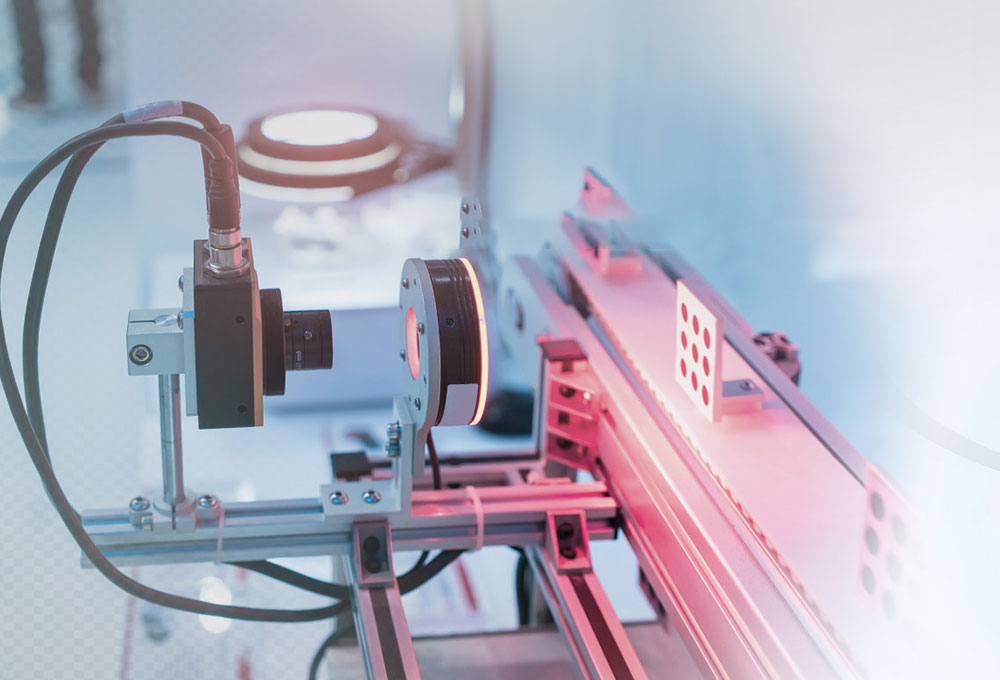
Composition and Working Process of Machine Vision Systems
A complete machine vision system includes lighting sources, optical lenses, CCD cameras, image acquisition cards, image inspection software, monitors, and communication units.
The working process of an industrial machine vision system mainly includes:
1. The image capture board according to claim 1, wherein a trigger pulse is sent when the sensor detects that the object being detected is moving toward the imaging center of the camera.
2. The image acquisition card sends trigger pulses to the illumination system and the camera, respectively, according to the set program and delay.
3. A start pulse is sent to the camera, which ends the current shot and begins a new one. Alternatively, the camera enters standby mode before the start pulse arrives, and upon detecting the pulse, it initiates the process by opening the exposure components prior to starting the new photograph (exposure time preset). Another start pulse is simultaneously sent to the light source, whose activation duration must match the camera's exposure time. The camera then scans and outputs the image.
4. The image capture board receives signals, digitizes analog signals through an A/D converter, or directly receives digital video data already digitized by the camera.
5. The image acquisition card stores the digital image in the computer's memory.
6. The computer processes, analyzes, and recognizes the image to obtain detection results.
7. Control pipeline operations, positioning, and correction of motion errors, etc.



 Ms.Cici
 8618319014500